









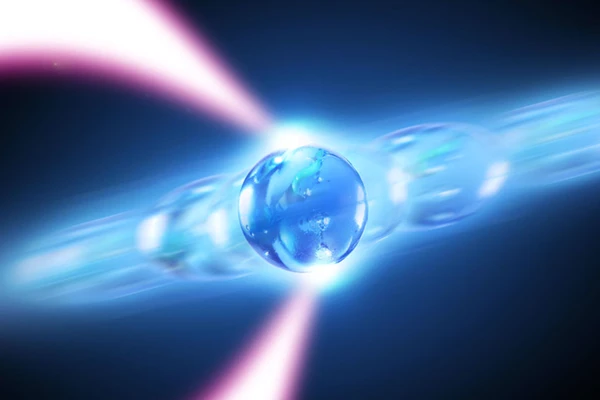
Scientists in China have created an unprecedentedly bright laser that shoots particles of sound instead of light.
About Sound Laser:
- At the core of the device is a one-micrometre-long silica bead.
- Unlike traditional lasers, which emit photons (particles of light), these devices emit phonons, which are particle-like units of sound.
- The output is similar, with the particles being emitted in a narrow beam, much like optical lasers emit photons.
- Phonons are less affected while moving through liquids, and can be more effective in imaging watery tissues and deep monitoring.
- Also known as Sound Amplification by Stimulated Emission of Radiation (SASER), these “sound lasers” produce a beam of uniform sound waves on a nano scale.
- The first successful SASERs were developed in 2009.
Application:
- These particles find applications in optoelectronics, terahertz-frequency ultrasound, signal modulation, and manipulating nanoparticles.
- Operating in the terahertz frequency range, the beam can also penetrate clothing in airport scans for security purposes.
About the device:
- It is the most powerful “sound laser” yet.
- The new device utilizes a micrometer-long silica bead, levitated by two beams of light within a reflective cavity.
- Vibrations in the bead of the “sound laser” generate phonons, which are then amplified within the cavity before being emitted.
Ref:Source
| UPSC IAS Preparation Resources | |
| Current Affairs Analysis | Topperspedia |
| GS Shots | Simply Explained |
| Daily Flash Cards | Daily Quiz |