








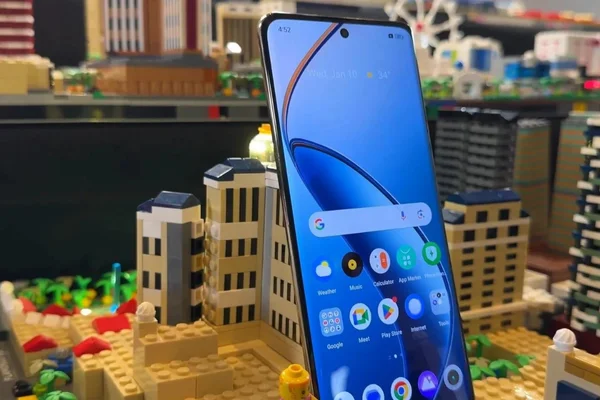
The Telecommunication Engineering Centre (TEC) has flagged challenges that could crop up in the implementation of the direct-to-mobile (D2M) technology, which would pave the way for streaming television content directly to mobile phones, without an internet connection.

What is D2M?
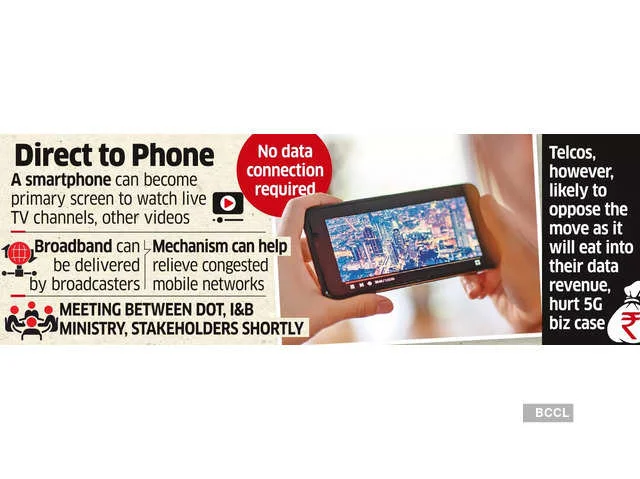
- D2M is a broadcasting technology designed to transmit multimedia content directly to consumers’ smartphones without the need for an active internet connection.
- Traditionally, it has been employed for issuing emergency alerts and assisting in disaster management.
- However, its versatility extends beyond these conventional applications.
- D2M allows governments to broadcast citizen-centric information, and telecom operators can collaborate with content providers to deliver multimedia content, including live news, without putting excessive strain on network bandwidth.
- This approach benefits consumers by reducing their reliance on internet data consumption for staying informed and entertained.
How does D2M technology work?
- D2M technology functions in a manner similar to listening to FM radio on a smartphone, where a receiver taps into radio frequencies.
- Another comparison is direct-to-home (DTH) broadcasting, in which a dish antenna receives broadcast signals directly from satellites and transmits them to a receiver, known as a set-top box.
Why it is not ready for rollout?
- Currently, mobile devices lack support for D2M technology as it requires the ATSC 3.0 standard.
- ATSC 3.0 represents the latest version of the Advanced Television Systems Committee standards, designed to define how television signals from different networks, including terrestrial, satellite, and cable networks, are broadcasted and interpreted by devices.
- To make devices compatible, a separate baseband processing unit, antenna, low-noise amplifiers, baseband filters, and a receiver are needed, increasing smartphone costs and potentially disrupting LTE and 5G network designs.
- The current network infrastructure is not equipped to transmit signals for D2M.
- It requires a dense network of terrestrial towers to receive signals from satellites and transmit them to devices, necessitating smaller device antennas.
Alternative to D2M:
- An alternative to D2M is 5G Broadcast technology, currently undergoing testing.
- It utilizes high towers with powerful transmitters to distribute media content via continuous, linear data streams.
- This approach eliminates the need for a new processing unit, potentially reducing device costs.
- 5G Broadcast is compatible with both 5G and 4G, operates within the existing network setup, and eliminates the need for a separate processing unit.
- It utilizes high towers with powerful transmitters for efficient content distribution.
Ref: Source
| UPSC IAS Preparation Resources | |
| Current Affairs Analysis | Topperspedia |
| GS Shots | Simply Explained |
| Daily Flash Cards | Daily Quiz |