









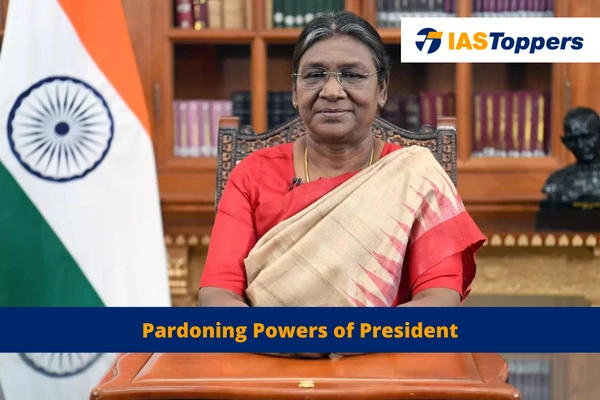
The President’s power to grant pardons, enshrined in Article 72 of the Indian Constitution, is a fundamental tool in maintaining a fair and just legal system. The President has the authority to grant pardons, reprieves, respites, or remissions of punishment, or suspend, remit or commute the sentence of any person convicted of any offence. In this article, you will learn about Definition and Meaning of Pardon power of President and Governor, Process of Pardoning, Types of Pardoning, Supreme Court Guidelines etc. It is very important topic for GS Paper-2 Polity & Governance of UPSC CSE Exam. To explore more interesting UPSC Polity concepts similar to Pardoning Powers of President in India, check out other articles of IASToppers.
Table of Content
- What is Pardoning power of president?
- Objectives of the President’s Pardoning Power
- Process of granting pardon in India
- When Can the President Exercise Pardoning Power?
- Judicial Review of the President’s Pardoning Power
- Types of Pardoning Powers of the President
- Guidelines of Supreme Court
- Pardoning Powers of the US President
- Difference between Pardoning powers of President and Pardoning Power of Governor
- Conclusion
- FAQs on Pardoning Powers of President of India
What is Pardoning power of president?
- Article 72 of Indian Constitution empowers the President to grant pardons, reprieves, respites or remissions of punishment or to suspend, remit or commute the sentence of any person convicted of any offence.
- He can pardon in all cases where the:
- Punishment or sentence is for an offence against a Union Law;
- Punishment or sentence is by a court martial (military court); and
- Sentence is death sentence.

Objectives of the President’s Pardoning Power
The pardoning power serves several essential objectives:
- Protect innocent individuals from unjust punishments or wrongful convictions.
- Encourage good behaviour among convicts by offering the possibility of being pardoned.
- Maintain a fair and just legal system, acknowledging that the human judicial system can never be entirely error-free.
Process of granting pardon in India
- The process starts with filing a mercy petition with the President under Article 72 of the Constitution.
- Such petition is then sent to the Ministry of Home Affairs for consideration.
- The petition is debated and discussed between the Home Ministry and the respective State Government.
- After the consultation, recommendations are made by the Home Minister and then, the petition is sent back to the President.
Judicial Review of the President’s Pardoning Power
In a number of court cases, the judiciary has scrutinized the authority of the President to grant pardons and determined various criteria for evaluating this power. Some significant cases are:
- Maru Ram vs. Union of India: The Supreme Court held that this power should be exercised based on the Central Government’s recommendation under Article 72, rather than the President acting autonomously.
- Swaran Singh vs. State of U.P: The court declared the Governor’s directive as capricious and arbitrary, leading to its annulment.
- Kehar Singh vs. Union of India: The court held that Presidential power to pardon represented an act of mercy and, as such, could not be asserted as an entitlement and was not subject to judicial review.
- Epuru Sudhakar vs State of A.P.: Supreme Court established the principle that power of president is subject to judicial review in some cases. Both Supreme Court and High Court have a limited right to review the pardon power of governor and president. The President’s or Governor’s act of clemency can be contested if
- Order has been made without thoughtful consideration.
- Order is made in bad faith.
- Order is based on entirely irrelevant factors.
- Pertinent information has been disregarded in the decision-making process.
- Order is capricious.
Types of Pardoning Powers of the President
- Pardon: The president can totally absolve/acquit the person for the offence and let him go free like a normal citizen.
- Commute: To reduce the type of punishment into a less harsh one. For example, Rigorous imprisonment to simple imprisonment.
- Remission: To reduce the punishment without changing the nature of the punishment. For example, 20 years rigorous imprisonment to 10 years rigorous imprisonment.
- Reprieve: A delay is allowed in the execution of a sentence, usually a death sentence for a guilty person to prove his innocence.
- Respite: Reduce the degree of punishment looking at specific grounds like pregnancy, old age etc.
- A Court-martial is a trial in a military court of a member of the armed forces who are charged with breaking military law.
Guidelines of Supreme Court
The Supreme Court examined the pardoning power of Indian President under different cases and laid down the following principles:
- Individuals seeking mercy have no entitlement to an oral hearing with the President.
- The President has the prerogative to re-evaluate the evidence and form an opinion differing from the court’s judgement.
- The President’s use of this authority is based on the advice of the union cabinet.
- There is no obligation for the President to provide justification for his decision.
- The President has the ability to provide relief not only for excessively severe sentences but also for apparent errors.
- It is not necessary for the Supreme Court to set specific criteria governing the President’s use of this power.
- Presidential decisions regarding pardons are not open to judicial review, except in cases where the decision is arbitrary, unreasonable, mala fide (made in bad faith), or discriminatory.
- If a previous mercy petition has been denied by the President, one cannot obtain a stay by submitting a new petition.
Pardoning Powers of the US President
- The President of the US has the constitutional right to pardon or commute sentences related to federal crimes.
- The President is not answerable for his pardons and does not have to provide a reason for issuing one.
Difference between Pardoning powers of President and Pardoning Power of Governor
The pardoning power of President in India is wider than the governor and it differs in the following two ways:
- The President can grant pardons in cases where the punishment is by a Court Martial but Article 161 does not provide any such power to the Governor.
- Article 161 (pardoning power of governor) is related to the Power of Governor to grant pardons, reprieves, etc, and to suspend, remit or commute sentences in certain cases.
- The President can grant pardon in case death sentence but pardoning power of Governor in India does not extend to death sentence cases.
- Although state laws may mandate death sentence, the authority to issue a pardon rest with the President and not with the governor. However, the governor has the ability to suspend, reduce, or commute a death sentence.
- Both the governor and the President, have concurrent power over the suspension, reduction, and commutation of death sentences.
Conclusion
The pardoning power of the president in the Indian constitution extends beyond just issuing pardons; it includes granting reprieves, respites, remissions, and commutations. The same authority lies with State Governors, ensuring no conflict despite the similar powers. However, the power of the president to pardon is not without limits as it is leans heavily on the counsel of ministers, without a specified procedure for mercy petitions, which may lead to potential misuse by the ruling party.
Ref:Source-1
| Other Articles in Polity & Governance | |
| Citizenship of India | Societies Registration Act, 1980 |
| Governors of States | Inter-State Council |
| Article 12 of the Indian Constitution | Societies Registration Act, 1980 |
FAQs(Frequently Asked Question)
What is the pardoning power of president under article 72?
The President of India, as per Article 72 of the Indian Constitution, has the right to grant pardons, reprieves, respites, or remissions of punishment or suspend, remit, or commute sentences in certaincases.This power extends to all cases where the sentence is a sentence of death.
Is pardoning power of president of India discretionary?
The pardoning power of the President of India is not entirely discretionary. Although the President has the authority to grant pardons, as determined in the Union of India vs Sriharan (2016), the power of the President to grant pardon to a convict must be exercised based on the advice of the Council of Ministers.
What is the difference between president’s and governor’s power to pardon in case of capital punishment?
The President can grant pardon in case death sentence but pardoning power of the Governor in India does not extend to death sentence cases.
Is pardoning power of president executive or judicial?
The pardoning power of the President is executive power.
Should the president of India have the power to pardon?
The power of pardon vested in the President of India is a significant constitutional provision, safeguarding the rights of the citizens and ensuring justice. It is a failsafe mechanism to rectify possible judicial errors in meting out punishment.
Why does the president of India have power to pardon?
The President of India has the power to pardon to ensure a balance of power in the legal system. This power serves as a final check against judicial errors or a mechanism to provide mercy in cases of extraordinary nature.
What are the main 5 pardoning powers of president?
5 pardoning powers of presidentare Pardon, Commute, Remission, Reprieve and Respite.
What is the difference between pardoning power of president and governor?
The main difference between the pardoning powers of the President and the Governor is the extent of their jurisdiction. While the President can pardon sentences imposed by a court-martial and death sentences, the Governor does not have these powers.