









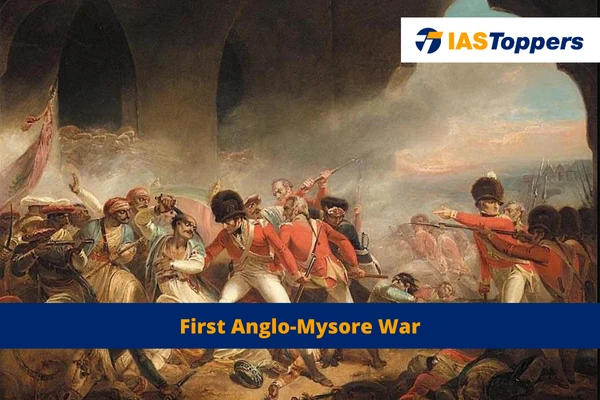
The First Anglo-Mysore War occurred due to the British East India Company’s desire for territorial expansion, and the threat posed by Hyder Ali’s growing power in Mysore. Major events included the initial attack on Mysore by Marathas and Nizam, their subsequent alliance with Hyder Ali against the British, and Hyder’s surprise attack on Madras leading to a peace treaty. In this article, you will know about Background, Causes and Consequences of First Anglo-Mysore. To explore more interesting UPSC Modern Indian History topics of GS Paper – 1 like First Anglo-Mysore war, check out other articles and IAS Notes of IASToppers.
Table of Content
- Background of First Anglo-Mysore War
- Causes of First Anglo-Mysore War
- Consequences of First Anglo-Mysore War
- Conclusion
- FAQs on First Anglo-Mysore War
Background of First Anglo-Mysore War
- The 18th century in the Indian subcontinent was marked by significant political unrest.
- After Emperor Aurangzeb’s death in 1707, the once-powerful Mughal Empire began to crumble.
- Various local rulers and viceroys vied for control.
- British and French colonial companies became deeply involved in these conflicts, particularly during the Third Carnatic War (1757-1763).
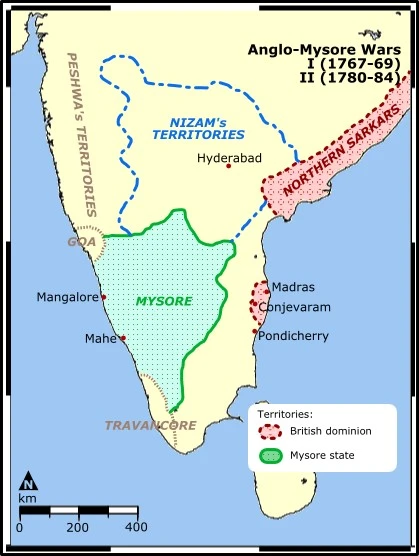
- Amidst this, 3 main regional powers emerged: the Nawab of Carnatic, the Nizam of Hyderabad, and the Sultanate of Mysore.
- The Nizam had already declared independence from the Mughal Empire in the 1720s.
- Mysore, under the rule of the Wadiyar dynasty, was under threats from the Marathas, Travancore, Hyderabad, and the British in Madras.
- Ongoing disputes led to the depletion of Mysore’s treasuries, undermining the royal family’s control over the kingdom. Sensing an opportunity, Hyder Ali stepped in, ascending to a position of power within the court.
- In the meantime, the Marathas, who posed a significant threat to Mysore, suffered a loss in the third battle of Panipat. This development worked in Hyder Ali’s favor, allowing him to solidify his reign over Mysore without any imminent.
- Hyder Ali eventually became the de facto ruler.
- Hyder Ali learnt modern warfare from the French during the Carnatic War, strengthening Mysore’s army and his own position.
- Mysore’s military capability was strengthened by income and tax changes, allowing Ali to finance a sizable army and extend the kingdom’s reach.
- Mysore also made notable weapon advancements, such as the use of portable rocket launchers.
- Mysore’s strong position evoked envy in the Marathas and the Nizam of Hyderabad.
- British East India Company, along with the Nizam and the Marathas, united against Hyder Ali due to their shared concerns over his rapid territorial gains. This started the first Anglo-Mysore war.
Causes of First Anglo-Mysore War
- The British East India Company (EIC) wanted a land route between its bases in Madras and Bengal, and aimed to control the Northern Circars (Sarkar – region) which were coastal regions under French control until 1758.
- After failing to lease the region from the Nizam of Hyderabad, they secured rights from the Mughal Emperor Shah Alam II in 1765.
- During this time, the Nizam and Marathas were worried about Hyder Ali’s growing power. Thus, they plotted an attack against Mysore.
- In response to the EIC’s takover of the Northern Circars in 1766, the financially weak Nizam negotiated a treaty with the EIC. This gave the EIC control over four Circars in return for financial or military protection of Nizam.
- Furthermore, several attempts by Hyder Ali to form an alliance with the British were failed. The refusal was due to the EIC considering it in conflict with the treaty they had with the Nizam.
Course of the First Anglo-Mysore War
- In January 1767, the Marathas attacked northern Mysore. They forced Haider Ali to surrender a portion of his land and pay them a yearly tribute.
- Next, the Marathas pulled back while the Nizam, supported by an English force, started an attack on Mysore, though it didn’t succeed fully.
- Despite mistrust, Haider and the nizam joined forces against the British and launched an attack on the British outpost at Changama.
- Confronted with their joint forces, the English leader, Colonel Smith, had to withdraw to Trichinopoly for supplies and reinforcement.
- Haider had some small wins and then started attacking Ambur in 1767. This made the British start fighting again.
- The British got the upper hand and got the Marathas to join them. This caused a split between Haider and the nizam.
- In 1768, the British invaded Mangalore (Hyderabad). This destroyed the Nizam’s morale.
- During Haider’s absence, the British took back several places. They moved to the south as far as Dindigul and planned to attack Bangalore.
- Hyder surprisingly attacked a small British base and lost many soldiers. After losing many times, Hyder got more soldiers and started winning again.
- Hyder quickly moved towards Madras. This made the British to make a peace deal called Treaty of Madras on 29 March 1769.
Consequences of First Anglo-Mysore War
- Treaty of Madras included terms for swapping prisoners and giving back territories each side had taken.
- It was also agreed that the English would assist Haidar Ali if he was under threat from another entity.
- Hyder Ali, feeling stronger after the First Anglo-Mysore War, started a war with the Marathas in 1770. As per the treaty, he hoped the British would assist him. But Britishers didn’t helped him.
- Thus, he made a deal with the Marathas and the Nizam to team up and fight against the British.
- This team-up led to the Second Anglo-Mysore War in 1780. This war hurt a lot of the Carnatic area and did not end the issues between Mysore and the British.
- These issues only ended in 1799 when Hyder’s son, Tipu Sultan, was defeated and killed.
Conclusion
The end of the First Anglo-Mysore War revealed the complex nature of political alliances and the pervasive influence of colonial ambitions, setting the stage for further conflicts and ultimately shaping the historical trajectory of the Indian subcontinent.
Ref: Source-1
| Other Articles in History & Culture | |
| Maratha Empire | Battle of Plassey 1757 |
| Battle of Buxar(1764) | Land Revenue Systems in British India |
| Subsidiary Alliance System | Foreign Travelers to India |
FAQs (Frequently Asked Questions)
First Anglo-Mysore war ended with which treaty?
The First Anglo-Mysore War concluded with the Treaty of Madras, marking a shift in regional power dynamics.
Who was the first Governor-General of British India during first Anglo Mysore War?
During the First Anglo-Mysore War, Warren Hastings was the first Governor-General of British India.
First Anglo-Mysore war fought between which two forces?
The First Anglo-Mysore War was fought between the British East India Company and the Kingdom of Mysore under Hyder Ali.
When was the first Anglo-Mysore war fought?
The First Anglo-Mysore War was fought from 1767 to 1769.
Who won first Anglo-Mysore war?
The First Anglo-Mysore War ended in a stalemate, with Hyder Ali retaining control of Mysore but agreeing to the Treaty of Madras with the British East India Company.