









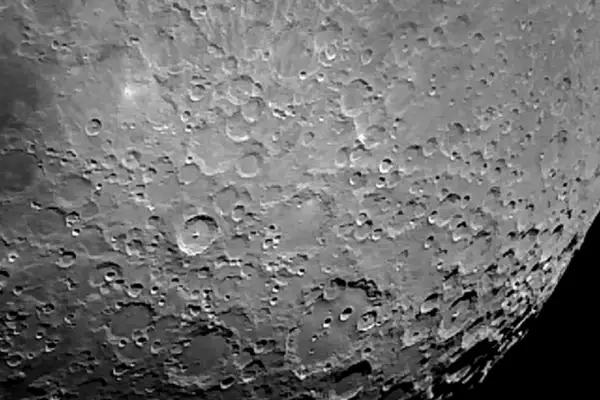
Chandrayaan-3’s Pragyan rover provided evidence supporting the Lunar Magma Ocean (LMO) Hypothesis through its findings using the Alpha Particle X-ray Spectrometer (APXS).

Key findings:
- Chandrayaan-3 identified ferroan anorthosite, a crucial rock type, in the lunar south pole region.
- This discovery aligns with earlier Apollo and Luna missions, indicating these rocks are remnants of an ancient lunar magma ocean.
- The findings support the Lunar Magma Ocean (LMO) Hypothesis, suggesting the Moon once had a molten surface.
- The discovery suggests that the Moon has largely retained its ancient surface due to minimal volcanic activity and plate tectonics.

What is LMO hypothesis?
- The Lunar Magma Ocean (LMO) Hypothesis proposes that after the Moon’s formation, its surface was entirely molten, forming a “magma ocean.”
- As this magma cooled, heavier minerals like olivine and pyroxene sank to form the Moon’s interior layers.
- Lighter minerals, such as calcium and sodium-rich minerals, floated to form the outer crust, including ferroan anorthosite.
Significance
- The LMO hypothesis is crucial for understanding the Moon’s early geologic history, including its differentiation process.
- It explains the formation of the Moon’s layered structure, which is observable today.
- The discovery of ferroan anorthosite provides substantial evidence for the hypothesis, enhancing our understanding of planetary formation.
Impact
- This evidence solidifies the Moon’s geologic history and contributes to broader planetary science.
- It suggests the Moon’s ancient surface has remained largely unchanged, offering a pristine record of early solar system history.
- These findings also indirectly connect to broader scientific concepts, like Einstein’s theory of general relativity, by illustrating how the Moon’s environment, including its gravity, differs from Earth’s.
Ref: Source
| UPSC IAS Preparation Resources | |
| Current Affairs Analysis | Topperspedia |
| GS Shots | Simply Explained |
| Daily Flash Cards | Daily Quiz |
Frequently Asked Question:
What is the Lunar Magma Ocean Hypothesis?
The Lunar Magma Ocean Hypothesis suggests the Moon’s surface was once molten, forming layers as it cooled.
Why is ferroan anorthosite significant?
Ferroan anorthosite is crucial as it provides evidence supporting the Lunar Magma Ocean Hypothesis.