









India’s recent payment in rupees for crude oil from the UAE is a noteworthy step in promoting the Internationalisation of rupee.

What does internationalisation of rupee mean?
- Internationalisation is a process that involves increasing the use of the rupee in cross-border transactions.
- The process involves promoting the rupee in import and export trade, followed by its utilization in other current account transactions and eventually expanding to capital account transactions.
- These transactions encompass dealings between residents in India and non-residents.
- The internationalisation of the currency, which is closely interlinked with the nation’s economic progress, requires further opening up of the currency settlement and a strong swap and forex market.
- Crucially, achieving full internationalisation will necessitate full convertibility of the currency on the capital account and unrestricted cross-border transfer of funds.
- Presently, India has granted full convertibility only on the current account.
- Currently, the dominant reserve currencies are the US dollar, Euro, Japanese yen, and pound sterling.
- China’s attempts to elevate the status of the renminbi as a reserve currency have seen limited success.
The dominance of the US dollar?
- Currently, the US dollar is said to enjoy an ‘Exorbitant Privilege’, which refers to the numerous benefits that accrue to the US on account of all other countries of the world using the US dollar as their currency in most of their international transactions, among global currencies.
- The US dollar’s supremacy is upheld by the size of the US economy, extensive trade and financial networks, deep and liquid financial markets, and a history of macroeconomic stability and currency convertibility.
- Dollar dominance is further strengthened by the absence of credible alternatives.
Challenging the dominance of the US dollar:
- The primary contender challenging the dominance of the US dollar is the Chinese Renminbi.
- However, its potential to rival the US dollar hinges on future policies in both the US and China.
- The success of the Renminbi will also rely on the Chinese economy and financial system demonstrating characteristics such as long-term resilience, integrity, transparency, openness, and stability, similar to those observed in the US economy.
Questioning of the US dollar-domination:
- Sanctions on Russia have made countries, including China and Russia, more cautious about potential repercussions.
- This has led to increased questioning of the US dollar-dominated global currency system by these nations.
- Following sanctions on Russia, many countries, including China and Russia, are wary of potential repercussions and are questioning the dominance of the US dollar in the global currency system.
- They would like to reduce their reliance on the US dollar and its financial markets as well as their dependence on dominant international payment mechanisms based on the Society for Worldwide Interbank Financial Telecommunications (SWIFT) messaging system.
Advantages of internationalisation of the rupee:
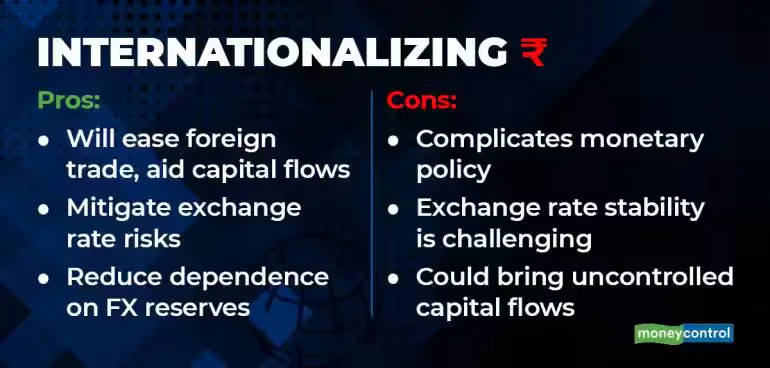
- The use of the rupee in cross-border transactions mitigates currency risk for Indian businesses.
- This protection against currency volatility not only lowers the cost of doing business but also fosters improved business growth, enhancing opportunities for Indian businesses to expand globally.
Decreased Need for Forex Reserves:
- While reserves effectively handle exchange rate volatility and ensure external stability, they also pose an economic cost.
- The internationalization of the rupee diminishes the necessity for maintaining extensive foreign exchange reserves.
- This reduced reliance on foreign currency enhances India’s resilience against external shocks, making the country less vulnerable to economic fluctuations.
Improved Bargaining Power:
- The rising significance of the rupee enhances Indian businesses’ bargaining power, strengthening the Indian economy and elevating its global stature and respect.
Difference between current account convertibility and capital account convertibility:
- The balance of payments account, representing all transactions between a country and the outside world, is divided into two accounts: the current account and the capital account.
- The current account primarily involves the import and export of goods and services, whereas the capital account comprises the cross-border movement of capital through investments and loans.
Current account
- Current account convertibility entails the freedom to convert rupees into other globally accepted currencies and vice versa without any restrictions when making payments.
Capital account convertibility:
- Capital account convertibility means the freedom to conduct investment transactions without any constraints.
- This involves no limitations on converting rupees into foreign currency for an Indian resident to acquire foreign assets.
- Similarly, there should be no restrictions on an NRI bringing in any amount of dollars or dirhams to acquire assets in India.
- Over the last three decades, India has made significant strides in liberalizing capital account transactions and currently maintains partial capital account convertibility.
- Developing nations exercise caution in opening their capital accounts due to the volatility associated with foreign and domestic capital inflows and outflows, which can lead to currency appreciation/depreciation and impact monetary and financial stability.
Other key facts:
- The Indian rupee was the official currency in Gulf countries, including Kuwait, Bahrain, Qatar, and the UAE, until the early 1970s.
- In 1959, the RBI was authorized to issue special notes exclusively for the Gulf region.
- These notes, known as the Gulf rupee or external rupee, held the same value as the Indian rupee.
- Additionally, Indians participating in the Haj pilgrimage could use Indian rupee notes, freely exchanging them for Saudi riyals.
- Subsequently, the government introduced special “Haj notes” with the inscription “HAJ” on them.
- However, the devaluation of the Indian currency in 1966 prompted several Gulf countries to discontinue the use of the Gulf rupee. By the early 1970s, all Gulf countries had ceased using the Gulf rupee as their currency.
How is internationalisation different from paying in rupee in foreign countries?
- Internationalisation of the Indian rupee means the currency will be used mainly for international trade and cross-border payments.
- However, when the Indian currency is used to make payments and buy things in a foreign country, it does not signify “internationalisation“.
- The Reserve Bank of India (RBI) has allowed banks from 18 countries to settle payments in the rupee.
- This includes names like Sri Lanka, Israel, Russia, Germany, Singapore and the United Kingdom.
- Apart from this, 64 other countries have expressed their intent to trade with India in rupee.
Ref: Source
| UPSC IAS Preparation Resources | |
| Current Affairs Analysis | Topperspedia |
| GS Shots | Simply Explained |
| Daily Flash Cards | Daily Quiz |