









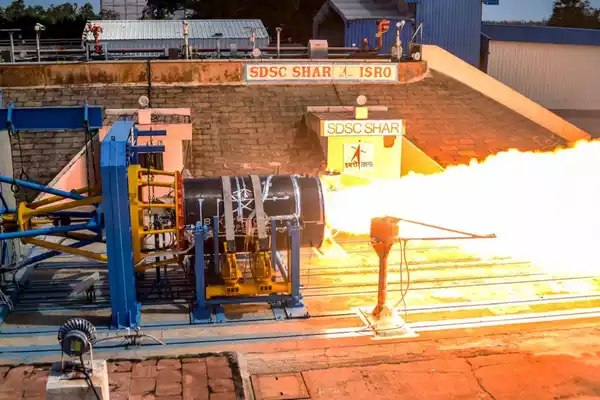
Skyroot Aerospace space-tech company successfully test-fired the Stage-2 of Vikram-1 space launch vehicle (Kalam-250) from Satish Dhawan Space Centre (SDSC) in Sriharikota.
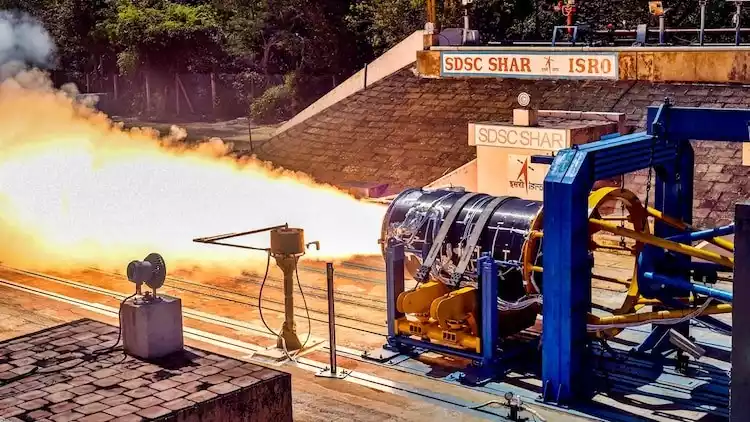
About Kalam-250:
- It is a stage-2 of Vikram-1 space launch vehicle which is crucial solid stage for
- It is a high-strength carbon composite rocket motor, which uses solid fuel.
- In addition, a high-performance Ethylene-Propylene-Diene terpolymers (EPDM) thermal protection system (TPS) is used.
- Kalam-250 incorporates a carbon ablative flex nozzle and electro-mechanical actuators for thrust vector control, critical for achieving desired trajectory during ascent.
- The Vikram Sarabhai Space Centre (VSSC) provided its proprietary head-mounted safe arm for testing, ensuring the safe operation of the rocket stage.
- This will serve as a key step in the ascent of the launch vehicle from Earth’s atmosphere to the deep vacuum of outer space.
About Vikram-1 Rocket:
- It is a three-stage launch vehicle with a capacity to place around 300 kg of payloads in Low-Earth Orbit (LEO).
- It is named after Dr. Vikram Sarabhai, the father of Indian Space program.
- India’s first commercial space rocket, ‘Vikram 1,’ developed by Skyroot Aerospace, a private space tech company.
- This multi-stage launch vehicle is designed for placing satellites into Low Earth Orbit (LEO), boasting a payload capacity of up to 300 kilograms.
- It represents a scaled-up iteration of the private firm’s earlier successful suborbital rocket launch, ‘Vikram S,’ in 2022.
- The rocket employs a combination of solid fuel in the lower stage and a liquid fuel mixture in the upper stages to propel itself into orbit.
- With an all-carbon-fiber body and 3D-printed liquid engines, Vikram-1 demonstrates advanced technology capable of deploying multiple satellites into orbit.
- Its relatively simple design allows for quick assembly and launch within 24 hours from any site, requiring minimal infrastructure.
- Two more launch vehicles (Vikram-2 and Vikram-3) would be launched as a part of Vikram series of space rockets after the completion of Vikram-1 mission.
Stages of Vikram-1:
- The rocket comprises three stages: Raman, Kalam-250, and Kalam-100.
- The Raman stage named after Nobel Laureate C.V. Raman, utilizes a bipropellant rocket engine,
- The Kalam-250 and Kalam-100 (tested in 2021) stages, named after Dr. A.P.J. Abdul Kalam, feature a high-strength carbon composite rocket motor for thrust and other functions.
| UPSC IAS Preparation Resources | |
| Current Affairs Analysis | Topperspedia |
| GS Shots | Simply Explained |
| Daily Flash Cards | Daily Quiz |