









The Prime Minister recently announced the ‘Pradhanmantri Suryodaya Yojana’ after the consecration of the Ram idol in Ayodhya.
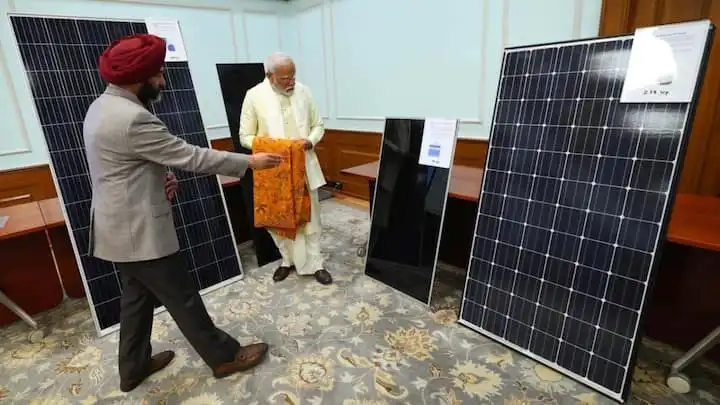
About the Pradhanmantri Suryodaya Yojana (PSY):
- The PSY aims to electrify 1 crore households throughout India, with installations of rooftop solar, emphasizing self-reliance in energy and reducing the electricity bills of the poor and middle class.
- The scheme will help generate additional income for poor and middle class in lieu of surplus electricity generation.
- Government’s target since 2010 was to produce 100 GW by 2022 (60 GW utility projects and 40 GW rooftop solar).
- The move aligns with the government’s vision of promoting clean and sustainable energy sources.
Other Government schemes for Installation of Solar plant:
- Grid Connected Solar Rooftop Programme: It will be implemented till 2026, and aims to achieve a cumulative installed capacity of 40,000 MW from Grid Connected Rooftop Solar (RTS) projects.
- Rooftop Solar Programme: It aimed to achieve a cumulative installed capacity of 40,000 MW of electricity by 2022.
- National Solar Mission: Its objective is to establish India as a globalleader in the solar sector by creating the appropriate policy conditions and to produce 20,000 MW by 2022 through mandatory use of Renewable Purchase Obligation (RPO).
- RPO mandates that all electricity distribution licensees should purchase or produce a minimum specified quantity of their requirements from Renewable Energy Sources.
- Solar Park Scheme: Its objective is to facilitate the solar project developers to set up projects expeditiously till 2026, by providing central financial assistance (CFA) of up to ₹25 lakh per solar park.
- UDAY (Ujwal DISCOM Assurance Yojana) Scheme: Launched in 2015, the scheme aims to develop renewable energy, with reduction of cost of power generation.
Status of Solar Installation in India:
- As of July 2023, about 56 GW were installed in utility projects, and 12 GW in rooftops.
- Nearly 87% of the approximately 12 GW rooftop solar installations are non-residential.
- As of July 31, 2023, only 2.2 GW of rooftop installations were reported, far below the target of 40 GW by 2022.
- In terms of total solar capacity generation, Rajasthan is at the top with 18.7 GW, and Gujarat is at the second position with 10.5 GW.
- In terms of installation of rooftop solar capacity, Gujarat tops the list, followed by Maharashtra.
- India usually adds less than 2 GW annually, with most installations being in offices and buildings.
Ref: Source
| UPSC IAS Preparation Resources | |
| Current Affairs Analysis | Topperspedia |
| GS Shots | Simply Explained |
| Daily Flash Cards | Daily Quiz |