









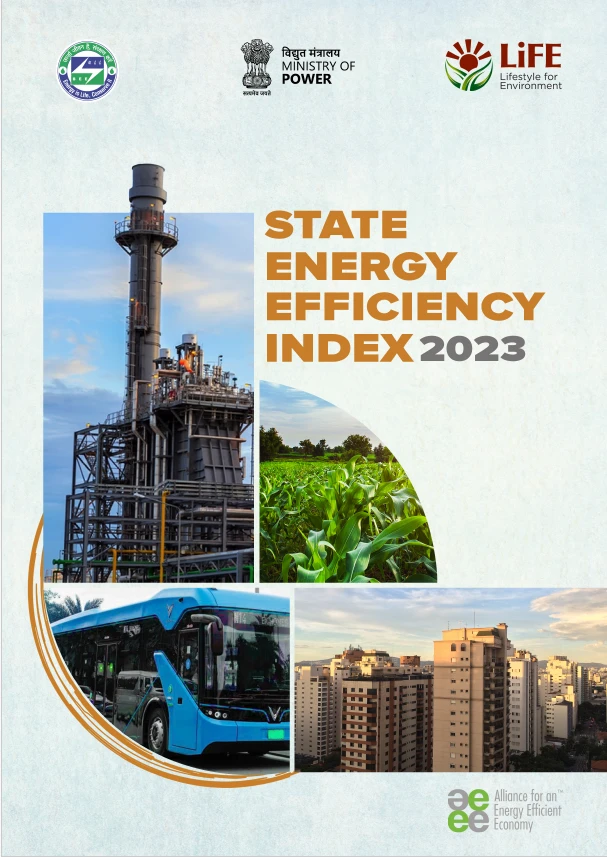
The State Energy Efficiency Index 2023 was released recently on the 22nd Foundation Day of The Bureau of Energy Efficiency (BEE).
About the State Energy Efficiency Index (SEEI):
- It was initiated by Bureau of Energy Efficiency (BEE), in association with Alliance for an Energy Efficient Economy (AEEE).
- It aimed to evaluate the annual progress of energy efficiency implementation in the states.
- SEEI identifies and addresses gaps concerning state-level energy efficiency policies, programmes, and investments.
- Energy efficiency (EE) is the cheapest, fastest and cleanest solution to complement renewable energy in addressing climate change and achieving energy security.
Key Findings of SEEI 2023:
- It assessed the performance of 36 states and UTs using 65 qualitative, quantitative, and outcome-based indicators measures distributed across seven demand sectors.
- This included buildings, industry, municipal services, transport, agriculture, electricity distribution companies (DISCOMs), and cross-sector initiatives.
- The states and UTs are categorized as ‘Front runner’ (>=60), ‘Achiever’ (50-59.75), ‘Contender’ (30-49.75), and ‘Aspirant’ (<30) based on their total scores.
- All the states and UTs are classified into four groups based on their total final energy consumption (TFEC):
- Group 1 (>15 million tonnes of oil equivalent (MTOE)),
- Group 2 (5-15 MTOE),
- Group 3 (1-5 MTOE),
- Group 4 (<1 MTOE).
- The top-performing states in each group are Karnataka (Group 1), Andhra Pradesh (Group 2), Assam (Group 3), and Chandigarh (Group 4).
- Karnataka is the top-performing state in SEEI 2023, with the only active “Energy Conservation and Energy Efficiency Policy,” among India.
- It implemented significant measures in the buildings, industries, transport, municipal services, and agriculture sectors.
- The second-highest performer, Andhra Pradesh adopted a multi-faceted approach to energy efficiency involving policy formulation, financial incentives, capacity-building, etc.
- 15 states have improved their scores compared to SEEI 2021-22.
- Four states—Goa, Uttar Pradesh, Maharashtra and Haryana demonstrated significant progress, improving by over 10 points relative to SEEI 2021-22.
- The most improved states in this assessment are Maharashtra and Haryana.
About Bureau of Energy Efficiency (BEE):
- It was formed under the provisions of the Energy Conservation Act, 2001 by the Ministry of Power.
- The primary objective of reducing energy intensity of the Indian economy can be achieved.
- The theme for 2024 was “Energy Transition through Electrification and Decarbonization in lndia”.
Role of BEE:
- BEE has helped India reduce its energy consumption by around 3.5%.
- Its efforts have resulted in reduction of carbon dioxide emissions of more than 306 million tonnes per annum.
- It is primarily because of BEE that India could achieve its NDC target of reducing emission intensity of GDP 11 years ahead of target.
- BEE’s schemes and programmes have been innovative, world-leading and are being copied across the world.
Other Key Initiatives:
Standards and Labeling Program for Packaged Boilers:
- It was launched to improve the energy efficiency of packaged boilers and facilitate consumers make informed choices.
- Packaged Boiler is a factory-made ready-to- use boiler, used for requirement of steam and hot water for all process industries.
- It includes 1-5 star ratings for each packaged boiler based on its thermal efficiency on the Net Calorific Value (NCV) basis, 1-star being the minimum energy performance level.
- The program specifies the essential characteristics of packaged boilers being manufactured, commercially purchased, sold, or imported in India.
- The program is being launched under voluntary phase, valid up to 31st December, 2026.
- The penetration of EE label boilers is expected to increase from 10% in 2024 to 100% in 2033.
- From 2024-2033, it could lead to cumulative energy savings of ~ 3.1 million Tonnes of Oil Equivalent (TOE) and emission reduction of 7.23 million Tonnes of carbon dioxide equivalent.
Standards and Labelling Program for Visi Cooler:
- Commercial Beverage Cooler or Visi Cooler was added to BEE’s S&L Programs.
- The Standards and Labeling Program for commercial beverage cooler has been launched under voluntary phase, with validity till 31st December, 2026.
- The labeling fee for affixation of label on each unit (Commercial Beverage Coolers) will be 5 rupees for 1st year and increase till it becomes mandatory.
- Its implementation is expected to yield energy savings of 11.67 Billion kWh between 2024 and 2034 and reduction in carbon dioxide emissions of 8.35 Million tons.
- Visi Coolers are self-contained bottle coolers with a transparent glass front door, used to store bottled or canned beverages for sale in retail outlets.
- They are used by various businesses like grocery stores, restaurants and supermarkets that sell packaged beverages.
India EV Digest:
- BEE has examined implementation status of e-mobility programmes at state level, based on 15 criteria according to 49% expected CAGR in EVs during 2022-2030.
- It inputs the role of state governments in creating impact through policies conducive for adoption of e-mobility.
- These criteria include provisions in state tariff-related, public EV charging infrastructure, e-mobility awareness activities, and promotion of e-mobility in public transportation.
- It presents current e-mobility policy and regulatory regime at National and sub-national levels, market trends across the e-mobility ecosystem.
- Its recommendations include creating awareness, managing demand and supply-side incentives for e-mobility adoption by state EV policies.
- This is supported by coordination with state DISCOMs, timely grant of connection to public charging stations and aggressive role for state nodal agencies.
- Creation of EV Accelerator Cells to serve as single-window entity for coordination and implementation of e-mobility programs in respective states.
Ref:Source
| UPSC IAS Preparation Resources | |
| Current Affairs Analysis | Topperspedia |
| GS Shots | Simply Explained |
| Daily Flash Cards | Daily Quiz |