









The United Nations Environment Programme (UNEP) and WRAP (Waste and Resources Action Programme), a U.K.-based non-profit, have released the Food Waste Index Report 2024 ahead of the International Day of Zero Waste (March 30).
About Food Waste Index (FWI):
- The Food Waste Index tracks the global and national generation of food and inedible parts wasted at the retail and consumer (household and food service) levels.
- UNEP is its custodian.
- The Food Waste Index allows countries to measure and report on food loss generated in manufacturing processes, which would not be captured under key commodity losses by the Food Loss Index.
Achieving Sustainable Development Goal (SDG) 12.3:
- FWI assesses progress towards Sustainable Development Goal (SDG) 12.3, which is to be achieved by 2030.
- This goal targets the halving of per capita global food waste at the retail and consumer levels, along with reducing food lossesthroughout production and supply chains, including post-harvest losses.
- Indicator 12.3.1A: The Food Loss Index (FLI) measures losses along the food supply chain starting from post-harvest losses on the farm up to but not including retail stage.
- Indicator 12.3.1B: In contrast to the Food Loss Index, the Food Waste Index measures total food waste (rather than loss or waste associated with specific commodities).
Key Findings:
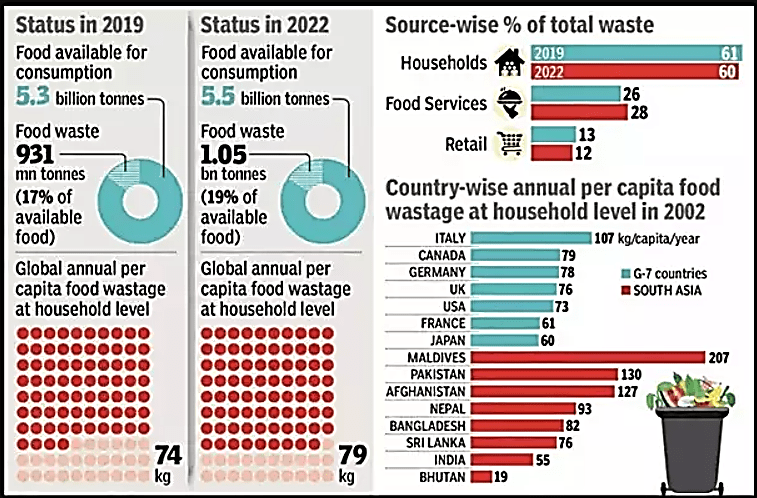
- Globally, 1.05 billion tonnes of food waste were generated in 2022, equivalent to nearly one-fifth of all food available to consumers.
- On average, each person wasted 79 kg of food annually in households worldwide, with India’s per capita waste at 55 kg per year.
- The economic toll of food loss and waste on the global economy is estimated at approximately $1 trillion.
- Despite such massive waste, 783 million people suffer from hunger, and a third of humanity faces food insecurity.
Distribution of Food Waste:
- 60% of food waste occurred at the household level, 28% at food services, and 12% at retail.
- Additionally, 13% of the world’s food is lost in the supply chain, exacerbating the problem.
- Notably, food waste is not solely a problem of affluent nations, as levels of household food waste vary minimally across income groups.
- Hotter countries tend to generate more food waste per capita, potentially due to higher consumption of fresh foods with significant inedible parts and inadequate cold chain infrastructure.
- Urban-rural disparities exist, with rural areas generally wasting less due to practices such as diversion of food scraps to pets and home composting.
Trends Over Time:
- The 2024 report compared data with the previous report from 2019, revealing an increase in per capita household food waste globally (from 74 kg to 79 kg) and in India (from 50 kg to 55 kg).
- Maldives had the highest per capita household food waste at 207 kg in 2022.
Environmental Impact:
- Food loss and waste contribute 8-10% of annual global greenhouse gas emissions, surpassing emissions from the aviation sector.
- It also leads to significant biodiversity loss, occupying nearly a third of the world’s agricultural land.
Policy and Action:
- Only 21 countries have incorporated food loss and waste reduction in their national climate plans under the Paris Agreement.
- Four G20 countries and the European Union have suitable food waste estimates for tracking progress towards 2030 goals.
- The Food Waste Index report urges countries to integrate food waste reduction measures into their climate plans by 2025 to enhance their climate ambition.
- Many low- and middle-income countries lack adequate systems for tracking progress towards Sustainable Development Goal (SDG) of halving food waste by 2030, especially in retail and food services.
Recommendations:
- Collaborative efforts through Public-Private Partnerships (PPPs) are crucial for driving innovation and overcome challenges in the fragmented food system, fostering long-term, holistic change.
- Governments, cities, municipalities, and food businesses must work together to reduce food waste and raise awareness among households.
- Utilizing the Food Waste Index to measure and track progress is essential for developing effective strategies and targeting interventions.
About WRAP:
- The WRAP is a British charity that works to promote a sustainable economy and protect natural resources.
- It was established in 2000 and is a climate action NGO that works to address the causes of climate change and create a more sustainable future for the planet.
- Suggestions for reducing food waste through a collaborative approach:
- Implement systemic action through Public-Private Partnerships (PPPs) models, such as the Courtauld Commitment 2030 in the UK or the Australian Food Pact.
Develop a roadmap or delivery plan that targets priority areas or “hotspots” of waste, focusing efforts on areas with the most significant potential for reduction
| UPSC IAS Preparation Resources | |
| Current Affairs Analysis | Topperspedia |
| GS Shots | Simply Explained |
| Daily Flash Cards | Daily Quiz |